
Consumer Report, March 2001 Page 24 - 25
Rain, Rain, Go Away
Do some jacket's fabrics keep you drier than others?
There was a time when the only waterproof raincoat was the rubber or vinyl slicker that looked so cute when you were a 6-year-old boarding the school bus. But even at age 6, you probably recognized its major drawback : The slicker didn't breathe. It kept rain out, but you grew damp from perspiration that was trapped inside. In cold weather you felt chilly; in hot weather, steamy.
Today's rain gear employs all sorts of fabric and treatments in an attempt to keep you dry. There are coatings (often polyurethane) and films (sometimes called membranes) that are applied to the inside of the shell fabric to keep water from reaching you. There are thin finishes applied to the outside of the shell fabric to help water bead up and roll off. There are laminates bonding several thin layers of different materials. Some manufacturers use a combination of methods, such as a laminate and a finish. Unlike that old slicker, much of the new breed of foul-weather gear "breathes". Most of films, and some coatings, are "microporous" -- they have tiny pores that let water vapor out without letting water in.
When you shop, you will see all sorts of fabric names, many of them trademarked. For help in translating them, see "Look at the Label," on the facing page.
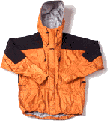 |
We tested nine widely sold jackets made with a variety of fabrics. Other jackets in the same materials and with similar construction should perform similarly (and increasingly, you'll find even dressy raincoats made of the fabrics we tested). As benchmarks, we also tested a cotton/nylon jacket with a water-repellent finish and a slicker jacket of Polyvinyl Chloride (PVC), expecting that the first would provide little rain protection and the second would create that saunalike feel. |
On the other hand, don't sit on a wet surface (for instance, on the on a stadium seat) unless you're wearing a PVC slicker. This is the only material that blocked water completely when we weighed the fabric and "sat" it on a wet surface. Although labels claim that Gore-Tex "prevents water entry through the fabric under any conditions you are likely to encounter," slightly more water went through Gore-Tex than through some other materials during our wet-seat test.
When tested for water-vapor transmission, almost all the jackets breathed very well. The exception here was (no surprise) our benchmark slicker.
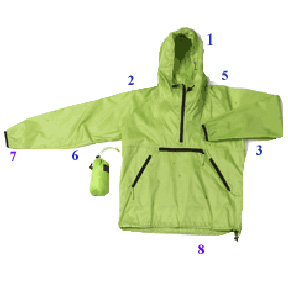 |
All Sewn UpHow a jacket is put together can determine whether or not it leaks or provides good ventilation. Here's what you need to know when you shop:
|
5. Storm Flap : A storm flap over the zipper or behind it provides extra protection. An extra fold ("gutter") in the storm flap can help channel water away.
6. Shaped Elbow : Sleeves with this kind of elbow are often labeled "articulated." They're more comfortable than straight ellbows.
7. Cuffs : The best incorporate elastic with an adjustable closure that often includes Velcro. Snaps are harder to use and less adjustable.
8. Chined Hem : You should be able to secure the bottom of the jacket so a whipping wind can't blow snow or rain underneath. Make sure the cinch can be easily opened for better ventilation. A cinch at the waist can be useful, too.
